
AHR-50 - Pratiques religieuses des gens de métier en Italie romaine : miroir et vecteur d’une identité socio-professionnelle
Préface : William Van Andringa
Mise en page : Virginie Teillet
mise en page couverture: Éditions Mergoil
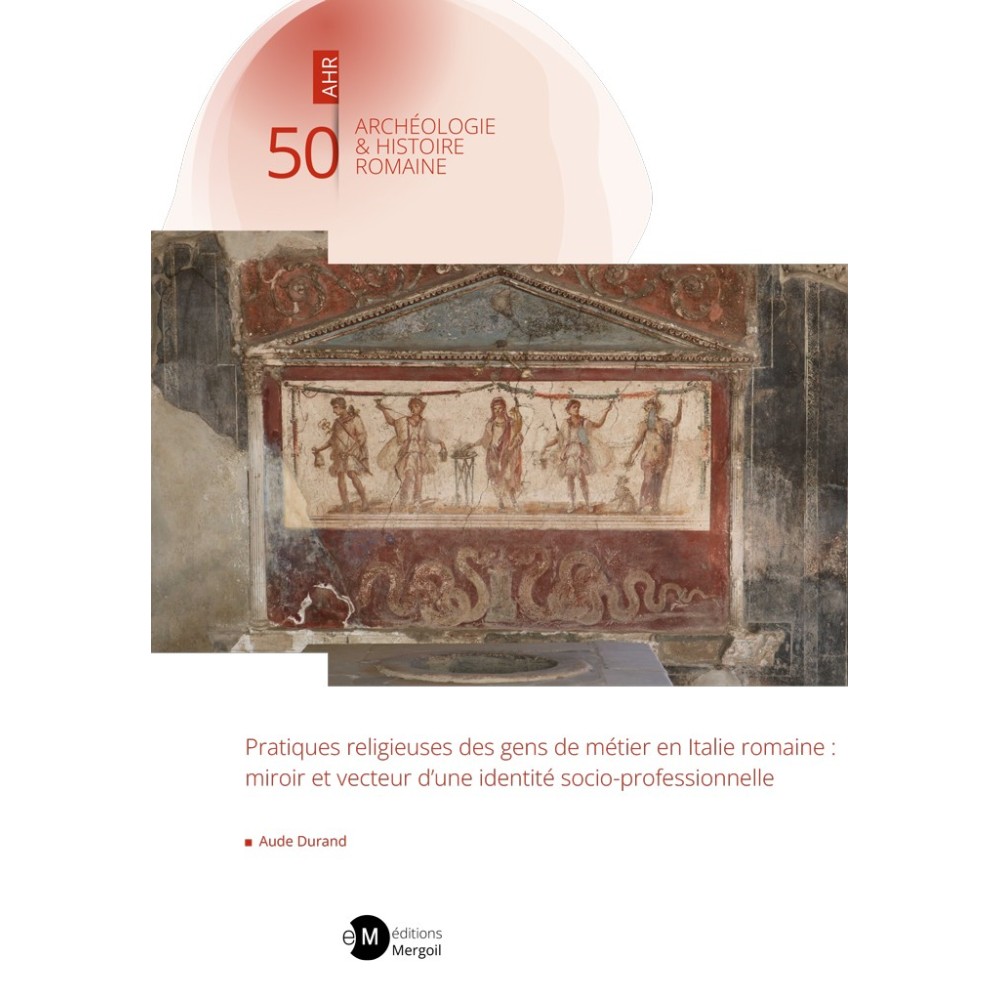
photographie : sacrarium du commerce alimentaire pompéien en I, 8, 8.9 (cliché de l’auteur ; sur concession du Ministero della Cultura et du Parco archeologico di Pompei).
langue : français.
diffusion : éditions Mergoil

Your transactions are protected by a secure connection

Books are shipped to France and worldwide, depending on stock availability.

For any questions regarding an order or a return, please contact us.
Religious practices of tradespeople in Roman Italy: mirror and vector of a socio-professional identity
This investigation aims to clarify the heterogeneity of «work statuses», as defined by J. Andreau, through the prism of the religious practices of tradespeople in Roman Italy. Focusing on Vesuvian cities and Ostia, the study of the religious topography, regarding work spaces and regarding urban fabric, makes it possible to analyse the way in which trades shape the landscape of a city, revealing disparate ways of living and working, as well as a variable involvement of local elites and institutions in the economic life. From an economy managed by the paterfamilias to an outstanding economy, linked to the supply of Rome, the socio-professional structures are transformed, so are the religious practices. The parallels offered by epigraphy and a few well-documented archaeological files enable us to broaden the comparison, in space and time, to the whole of the Italian peninsula, bringing to light local traditions, patterned after changing socio-political frameworks. This anthropological investigation questions the way in which rites are integrated into the environment and the daily practice of a trade and finally questions what makes the strength of the community links in the city: is it the family nucleus, the life in the neighbourhood or the activities within a professional association? From divine tutelage to human patronage, the pietas of tradespeople clearly expresses the multiplicity of issues at stake in the Roman religion, at the heart of social practices. Craftsmen and merchants certainly sought to protect their economic interests, but their civic existence was also at stake: worship festivities, religious arrangements and acts of devotion participated in the memorial construction of work communities and professional groups. It is therefore their own position on the scale of socio-professional hierarchies or their own proximity to the spheres of power that could be claimed, whether real or imagined.
Table des matières
LES GENS DE MÉTIER ET LES DIEUX AU TRAVAIL. Pratiques religieuses des artisans et des marchands au sein de leurs espaces de travail
- Panorama religieux des boutiques et ateliers des cités vésuviennes
- Rareté des sacraria dans les espaces de travail ostiens
- Rites en marge : symboles propitiatoires et pratique professionnelle
LES GENS DE MÉTIER ET LES DIEUX DANS LA VILLE. Pratiques religieuses des artisans et des marchands au sein du tissu urbain
- Imbrication du travail et de l’habitat dans les cités du Vésuve : des sacraria qui reflètent une organisation familiale du travail ?
- Réflexion sur l’absence. Établissements en location et religion
- Vie de quartier à Ostie. Le poids des communautés de voisinage dans le quotidien des gens de métier
LES DIEUX, LES GENS DE MÉTIER ET LES INSTITUTIONS . Pratiques religieuses des artisans et des marchands dans leurs rapports avec les sphères du pouvoir
- Divinités honorées par les associations professionnelles, entre protection et représentation
- Occuper l’espace urbain : une existence civique en jeu
Conclusion générale
Bibliographie
CORPUS ET ANALYSES DOCUMENTAIRES
Lieux de culte et autres témoignages religieux dans les boulangeries herculanéennes et pompéiennes
Lieux de culte et autres témoignages religieux dans les ateliers de textile herculanéens et pompéiens
Lieux de culte et autres témoignages religieux dans les commerces alimentaires et auberges herculanéens et pompéiens
Lieux de culte et autres témoignages religieux dans les autres espaces de travail herculanéens et pompéiens
Lieux de culte et autres témoignages religieux dans les établissements économiques ostiens
Lieux de culte et autres témoignages religieux dans les lieux de métier établis autour d’édifices publics
Lieux de culte et autres témoignages religieux dans les potentielles locations pompéiennes

Data sheet
Specific References
AHR-50 - Pratiques religieuses des gens de métier en Italie romaine : miroir et vecteur d’une identité socio-professionnelle
Préface : William Van Andringa
Mise en page : Virginie Teillet
mise en page couverture: Éditions Mergoil
photographie : sacrarium du commerce alimentaire pompéien en I, 8, 8.9 (cliché de l’auteur ; sur concession du Ministero della Cultura et du Parco archeologico di Pompei).
langue : français.
diffusion : éditions Mergoil